

Two recent events in the AAII model portfolios significantly increased their cash positions. First, Vistance Networks Inc. (VISN), which is held in the VMQ Stocks model portfolio, issued a special distribution of $10.00 per share in April. Then, on Tuesday, a portfolio deletion alert was issued for AAII Dividend Investing (DI) model portfolio holding Texas Instruments Inc. (TXN). The stock’s total gain since being added to the DI model portfolio in 2013 was nearly 1,200%.
Subscribers who own shares of Vistance Networks and/or chose to sell Texas Instruments may be wondering what to do with the extra cash. Realizing a big capital gain is a nice problem to have.
There is no single rule for what to do with a big influx of cash from a stock sale or return of capital. Rather, the choice depends on your personal situation. You can use the following guidelines to help determine what is best for you.
Account Type Considerations
The type of account where the cash lands influences what you do.
Taxable Accounts: If you sell an investment for a big gain, the proceeds will be taxable if held in a taxable account. Consider how much, if any, of the proceeds are needed to cover applicable capital gains taxes. The remaining amount can then be used for other purposes, including reinvestment. (A return of capital reduces your cost basis but does not trigger capital gains taxes as long as your cost basis remains above $0. However, your future capital gains taxes will be larger because of the reduced cost basis.)
Retirement Accounts: Capital gains realized and returns of capital received in an individual retirement account (IRA), Roth IRA or other retirement account are not taxable. This narrows the decision to funding an upcoming withdrawal—such as your required minimum distribution (RMD)—or reinvesting. Reinvesting is a possibility if your broker allows you to take an in-kind distribution to fulfill your RMD. (An in-kind distribution allows you to withdraw shares instead of cash.)
Allocation Considerations
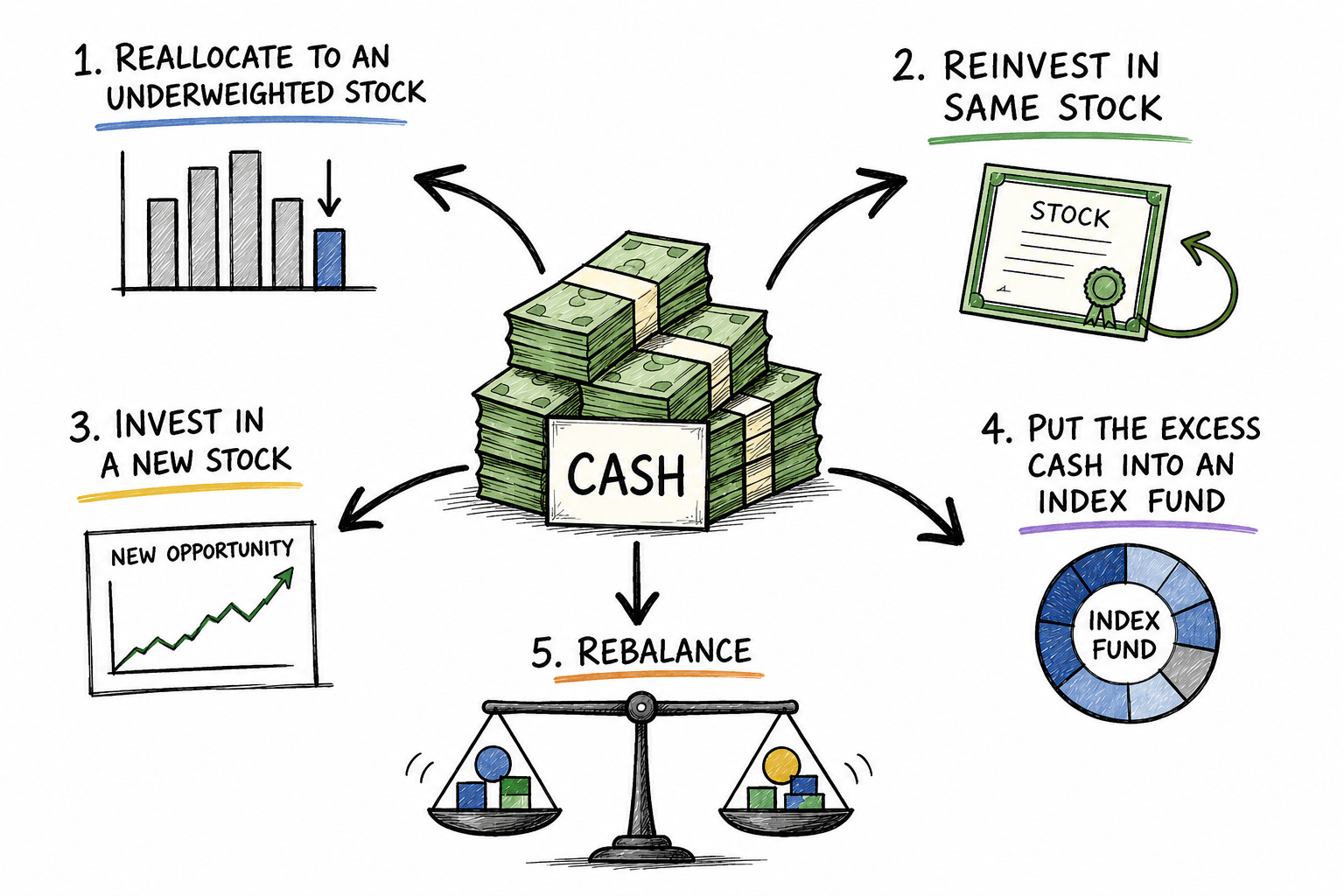
Here are the options for allocating the excess cash.
Reallocate to an Underweighted Stock: The AAII model portfolios follow a quasi-equal-weight approach. The target allocation is the average dollar size of all positions. For instance, the VMQ model portfolio holds 20 stocks. The target percentage allocation to each stock is therefore 5%. (In dollar terms, the calculation is total portfolio value divided by 20.) Several AAII portfolios, including VMQ and DI, reinvest excess cash into an underweighted holding that meets the strategy’s criteria. This approach helps reduce stock-specific (unsystematic) risk within the portfolio.
Reinvest in the Security That Returned Capital: If you still find the stock, real estate investment trust (REIT) or master limited partnership (MLP) that returned the capital attractive, you could reinvest in it. In doing so, understand that cost basis in the original position will have been lowered by the return of capital, while the reinvested amount will have its own cost basis.
Invest in a New Stock: The Model Shadow Stock Portfolio allocates the proceeds from a big gain in a removed stock among two or more stocks. This keeps one big position from turning into another big position. This is important because it is impossible to predict which stock will be the next big winner in your portfolio.
Put the Excess Cash Into an Index Fund: This is a good default option. It works particularly well if you are not ready to buy another stock right now—say, because you don’t have the time to research a new idea. Broad index funds allow you to maintain your allocation. Exchange-traded funds (ETFs) such as the iShares Dow Jones U.S. ETF
(IYY) are also easy to move out of once you identify a new stock or other security to invest in.
Rebalance: The influx of cash gives you an opportunity to rebalance your overall portfolio if it has strayed from your target allocation. This can involve boosting your exposure to foreign ETFs, bonds or other underweighted asset classes.
Keeping the proceeds in cash is also an option. While this works if there is a tax liability or a withdrawal need, there is always an opportunity cost to staying in cash rather than putting the excess back to work.

More on AAII.com
The Role Cash Plays in Individual Investors’ Portfolios
Insights into what investors do with their liquid investments and why.The Power of Holding Some Cash in a Portfolio
An allocation to cash can make sense in many portfolios both to reduce risk and, for retirees, to facilitate increased risk.Active Multisector Bond ETF Maintains Resilience Through Diversification
Our May 2026 AAII Journal fund manager interview reveals that a key tenet of PIMCO’s multisector portfolio is emphasizing diversification using a full macroeconomic toolkit.
AAII Sentiment Survey
Pessimism among individual investors about the short-term outlook for stocks decreased in the latest AAII Sentiment Survey. Meanwhile, optimism and neutral sentiment increased.
Bullish sentiment, expectations that stock prices will rise over the next six months, increased 0.2 percentage points to 38.3%. Bullish sentiment is above its historical average of 37.5% for the third time in 12 weeks.
Neutral sentiment, expectations that stock prices will stay essentially unchanged over the next six months, increased 6.6 percentage points to 28.7%. Neutral sentiment is below its historical average of 31.5% for the 94th time in 96 weeks.
Bearish sentiment, expectations that stock prices will fall over the next six months, decreased 6.7 percentage points to 33.3%. Bearish sentiment is above its historical average of 31.0% for the 13th consecutive week.
The bull-bear spread (bullish minus bearish sentiment) increased 6.9 percentage points to 5.4%. The bull-bear spread is below its historical average of 6.5% for the 12th time in 13 weeks.
This week’s special question asked AAII members what they thought about the Federal Reserve’s decision to keep interest rates unchanged.
Here is how they responded:
They should have raised rates: 7.5%
It was the right move: 71.7%
They should have cut rates: 15.0%
Not sure/no opinion: 5.8%
This week’s Sentiment Survey results:
Bullish: 38.3%, up 0.2 points
Neutral: 28.7%, up 6.6 points
Bearish: 33.0%, down 6.7 points
Historical averages:
Bullish: 37.5%
Neutral: 31.5%
Bearish: 31.0%
See more Sentiment Survey results.