

Most of you have likely filed your 2025 tax returns by now. The clock is ticking on the smaller number of you who have yet to file or request an extension. Either way, this week I ask you to focus on a specific number on your tax return that carries more importance than many taxpayers likely realize.
The number is your adjusted gross income (AGI). It is located on line 11a at the bottom of the first page of your 2025 Internal Revenue Service (IRS) Form 1040.
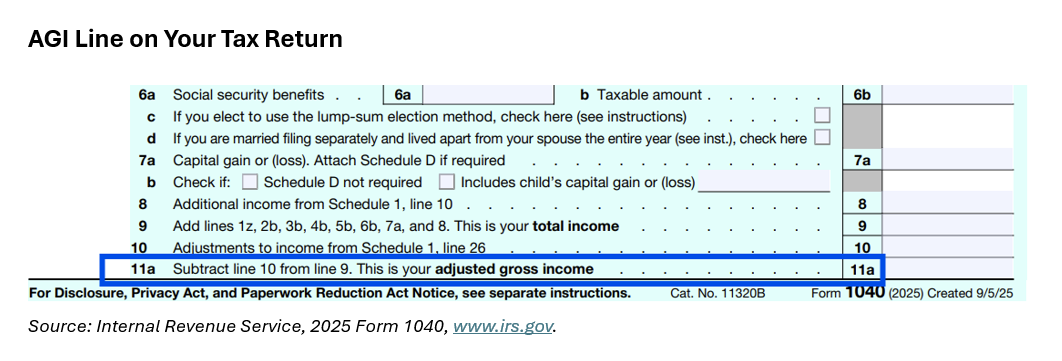
AGI is your wage income and other income you received—such as Social Security benefits, individual retirement account (IRA) distributions, capital gains, interest income, etc. These amounts are adjusted for contributions to IRAs and health savings accounts (HSAs), alimony paid, student loan interest deductions and other adjustments listed on Schedule 1 of Form 1040.
AGI matters because it either directly determines or is a major component in determining what and how much you can deduct. It also influences how much of your Social Security benefits are taxed for a given tax year and what you will pay in Medicare premiums two years out. Both combined income and modified adjusted gross income (MAGI) are based on AGI.
Below are some of the big things that AGI influences.
Charitable Deduction for Itemizers: AGI is typically the contribution base for individual taxpayers. Effective this year, charitable donations below 0.5% of your contribution base can no longer be deducted. If your AGI is $100,000, the first $500 of the donations made this year ($100,000 × 0.5%) are not deductible. The amount subject to the 0.5% floor can be carried forward for up to five years.
Combined Income: This is a variant of MAGI that is used to determine the percentage of your Social Security benefits that are taxed. It starts with your AGI, excluding any Social Security benefits received, and adds tax-exempt interest income and one-half of your annual Social Security benefits to that number.
Enhanced Deduction for Seniors: Married joint filers who are both at least 65 years old can claim an additional $12,000 deduction on their taxes between 2025 and 2028. Single filers who are at least age 65 can deduct $6,000. This deduction begins to phase out at MAGI of $150,000 for married joint filers and $75,000 for single filers. MAGI for most filers claiming this One Big Beautiful Bill Act (OBBBA) deduction will be AGI, except for those taxpayers with earned foreign interest or earned income from certain U.S. territories.
MAGI for IRMAA: Medicare’s income-related monthly adjustment amount (IRMAA) is based on a different definition of MAGI. Like other versions, MAGI for IRMAA starts with AGI from your Form 1040. It then adds back tax-exempt interest. Unlike other uses of MAGI, Medicare uses your current MAGI to determine your premiums for two years in the future. So, the IRMAA-based MAGI you earned in 2025 will determine what your Medicare premiums will be in 2027.
State and Local Tax (SALT) Deduction: MAGI for determining the start of the SALT deduction phaseout is $505,000 for tax-year 2026. Like the enhanced senior deduction, MAGI equals AGI for most taxpayers, except for those with earned foreign interest or earned income from certain U.S. territories. (The deduction for those with MAGI above $505,000 phases down gradually to $10,100 for 2026.)
Other OBBBA Tax Breaks: The MAGI limits for OBBBA deductions for tips, overtime and auto interest also use the same definition of MAGI as the enhanced senior and SALT deductions. For most taxpayers, this means that AGI will determine their eligibility for these tax breaks.
Traditional and Roth IRA Contributions: The income limits for deductible IRA contributions and Roth IRA contributions start with AGI and add back certain items, including the IRA deduction itself, the student loan interest deduction and the foreign income exclusion. Those receiving Social Security benefits should read Appendix B in IRS Publication 590-A for specific instructions.
Because AGI is mostly determined by income, the only way you can reduce it is to have less taxable income. Qualified charitable distributions (QCDs) satisfy required minimum distributions (RMDs) without the amount counting as taxable income. This reduces AGI dollar for dollar relative to taking the RMD. Roth IRA conversions increase AGI in the year they are made but reduce future AGI by shrinking the size of or eliminating RMDs. Realizing more tax-free interest, avoiding short-term capital gains and holding tax-inefficient investments in retirement accounts (e.g., IRAs, Roth IRAs, etc.) also help to reduce AGI.
To learn additional tax saving’s strategies, access the recordings and resources for the AAII Tax Seminar.
AAII Stock Bracket Challenge: Round 1 Results Are In
The first week of the AAII Stock Bracket Challenge is in the books, and it delivered the kind of upsets that make a bracket competition worth watching. Four of the eight first-round matchups went to the lower seed—including Coca-Cola Co. (KO) outlasting Microsoft Corp. (MSFT) and AT&T Inc. (T) edging out Chevron Corp. (CVX).
Advancing to the Quarterfinals: AbbVie Inc. (ABBV), Alphabet Inc. (GOOGL), Amazon.com Inc. (AMZN), Apple Inc. (AAPL), AT&T, Coca-Cola, JPMorgan Chase & Co. (JPM) and Pfizer Inc. (PFE).
MrZiggyD is the only player to have a perfect bracket after the first round. AZ Hot List and Blue Ants—as well as 10 other players—are tied for second place, each correctly picking seven of the eight first-round matchups.
The tournament is far from over.
The Quarterfinal round is running from April 1–7, closing at market close on Tuesday, April 7. Check your bracket, track live results and follow the leaderboard here.
Join us for our Week 2 live stream on Wednesday, April 8, at 1:00 p.m. Central Time for a full breakdown of the Quarterfinal results.
Reminder
The U.S. market and the AAII office will be closed on Friday, April 3, in observance of Good Friday. Wishing a happy Easter and a happy Pesach to those of you observing the respective holidays.

More on AAII.com
AAII 2025–2026 Tax Guide: What’s New for 2025–2026 Taxes
Learn how your taxes are affected by changes due to the OBBBA and the IRS inflation adjustments for 2026.For Qualified Charitable Distributions, Timing Is Everything
With careful planning, a QCD can be a smart tax-planning strategy for an IRA holder taking distributions.New Shadow Stock Addition and January Barometer Insights
The newly posted April 2026 AAII Journal reports one deletion and one addition for the Model Shadow Stock Portfolio after its quarterly review.
AAII Sentiment Survey
Neutral sentiment among individual investors about the short-term outlook for stocks decreased in the latest AAII Sentiment Survey. Meanwhile, optimism and pessimism increased.
Bullish sentiment, expectations that stock prices will rise over the next six months, increased 1.5 percentage points to 33.6%. Bullish sentiment is below its historical average of 37.5% for the seventh consecutive week.
Neutral sentiment, expectations that stock prices will stay essentially unchanged over the next six months, decreased 3.1 percentage points to 15.0%. Neutral sentiment is unusually low and is below its historical average of 31.5% for the 89th time in 91 weeks.
Bearish sentiment, expectations that stock prices will fall over the next six months, increased 1.6 percentage points to 51.4%. Bearish sentiment is unusually high and is above its historical average of 31.0% for the eighth consecutive week.
The bull-bear spread (bullish minus bearish sentiment) decreased 0.2 percentage points to –17.9%. The bull-bear spread is unusually low and is below its historical average of 6.5% for the eighth consecutive week.
This week’s special question asked AAII members how oil prices are affecting their perception of the economy.
Here is how they responded:
They will have a significant negative impact: 34.3%
It depends on how long oil prices remain at current levels: 24.2%
They will slow economic growth somewhat: 23.7%
I do not expect them to have a lasting impact: 16.5%
Not sure/no opinion: 0.9%
This week’s Sentiment Survey results:
Bullish: 33.6%, up 1.5 points
Neutral: 15.0%, down 3.1 points
Bearish: 51.4%, up 1.6 points
Historical averages:
Bullish: 37.5%
Neutral: 31.5%
Bearish: 31.0%
See more Sentiment Survey results.

AAII Asset Allocation Survey
Individual investors’ allocations to cash increased while stock and bond allocations decreased in the March AAII Asset Allocation Survey.
Stock and stock fund allocations decreased 0.2 percentage points to 69.2%. Stock and stock fund allocations are above their historical average of 61.5% for the 70th consecutive month.
Bond and bond fund allocations decreased 0.6 percentage points to 15.8%. Bond and bond fund allocations are below their historical average of 16.0% for the fifth time in six months.
Cash allocations increased 0.8 percentage points to 15.0%. Cash allocations are below their historical average of 22.5% for the 40th consecutive month.
March AAII Asset Allocation Survey results:
Stocks and Stock Funds: 69.2%, down 0.3 percentage points
Bonds and Bond Funds: 15.8%, down 0.6 percentage points
Cash: 15.0%, up 0.8 percentage points
March AAII Asset Allocation Details:
Stocks: 29.5%, down 1.3 percentage points
Stocks Funds: 39.7%, up 1.0 percentage points
Bonds: 5.1%, down 0.1 percentage points
Bond Funds: 10.7%, down 0.5 percentage points
Historical averages:
Stocks/Stock Funds: 61.5%
Bonds/Bond Funds: 16.0%
Cash: 22.5%
Take the Asset Allocation Survey.