

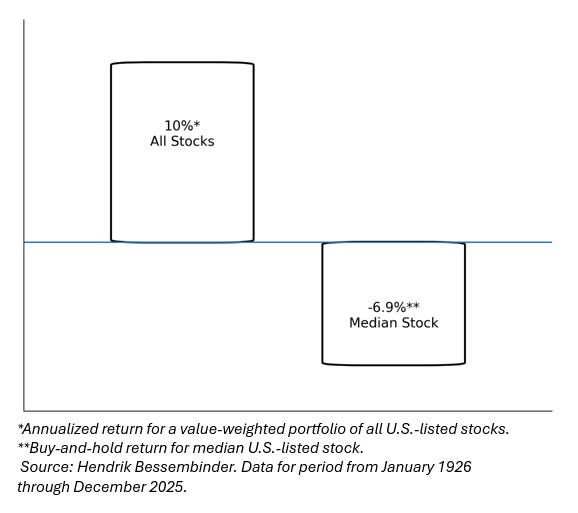
The median buy-and-hold return for individual U.S.-listed stocks over the past 100 years is –6.9%. Furthermore, only 48.2% of stocks generated a positive buy-and-hold return during the period of January 1926 through December 2025.
These are the updated findings of Hendrik Bessembinder. The Arizona State University business professor received much attention for his previous research showing that the stock market’s return has been attributable to just a small number of stocks. The median stock, in contrast, has lost value over the time it was listed.
Headlines and talking points from studies often obscure key details and takeaways. Bessembinder’s research is no different.
The first key detail is how Bessembinder calculated returns. He calculated buy-and-hold returns as “the final outcome per dollar initially invested for an investor who followed a buy-and-hold strategy, with each dividend reinvested in the same stock.”
Bessembinder calculated a 355.7% return for Reddit Inc. (RDDT) based on the period from March 21, 2024—when the stock went public—through December 31, 2025. This return assumes that an investor bought the stock on the day of its initial public offering (IPO) and never sold it. The same methodology was used for all stocks. Bessembinder used closing prices as of either the day those stocks stopped being listed (because they were acquired, delisted, etc.) or the end of 2025.
Bessembinder’s second measure of return is shareholder wealth creation. This measure “considers net distributions (dividends, spinoffs, share repurchases, new share issuances, etc.) as well as share price changes for each stock during each month, but is measured as of the end of the sample period.” It compares the change in wealth for a company’s shareholders relative to the one-month Treasury bills.
This metric found that 40.9% of stocks improved shareholder wealth, while 59.1% reduced shareholder wealth, compared to what an investor could have earned by holding Treasury bills instead.
While the numbers do not sound encouraging for individual investors, the calculations ignore a key action: buying and selling stocks instead of holding them until they are delisted or a terminal date is reached (e.g., your death). Attractive stocks can stop being attractive even for long-term investors.
A disciplined investing approach includes evidence-based rules for both buying and selling. Companies evolve and stock valuations change. What was once an attractive business several years ago may no longer be so today. Prudent investors part ways with stocks that no longer meet their criteria for buying and holding.
Bessembinder’s observation that the median stock appeared in his dataset for just 6.8 years supports the notion that investors should not hold a stock forever if it does not continuously meet their criteria. While some of these median stocks were acquired by competitors, others were delisted due to their own business struggles. All but the most optimistic investors either avoided or got out of self-driving truck company TuSimple Holdings Inc. before it was delisted in 2024. Yet its 83.7% loss of value is factored into Bessembinder’s calculations.
The professor also noted that a small group of stocks accounts for most of the gains. Apple Inc. (AAPL) and Nvidia Corp. (NVDA) account for a combined 10.6% of all shareholder wealth creation since 1926. Again, these numbers assume a constant buy-and-hold approach since the stocks first went public.
That said, it is not uncommon for a small number of stocks to have outsized influence on a portfolio’s return. Over the course of my career, I’ve seen seemingly boring or otherwise overlooked stocks deliver big returns. Identifying the biggest gainers in advance is difficult, which is why it is important to diversify. Overlaying disciplined sell rules prompts you to prune those stocks likely to hurt your portfolio’s returns and to hold onto those with better odds of boosting your returns.
Special Note
The AAII Stock Bracket Challenge is underway. Just like in the NCAA men’s basketball tournament, we are already seeing a fifth seed, AT&T Inc. (T), at risk of being upset by a 12th seed, Chevron Corp. (CVX). Starting next week, we will provide updates on the bracket along with insights on what’s moving the most popular stocks among AAII members. In the meantime, you can visit our How It Works page.

More on AAII.com
The Role of Diversification in an Individual Stock Portfolio
Managing the emotional realities of holding too many stocks or too few is one of the more subjective aspects of risk management through diversification.How to Buy and Sell Stocks Using AAII Stock Screens
The same criteria used by a screen to find attractive stocks can help you make disciplined decisions about when to sell stocks.Opportunities for Donor-Advised Funds Opened by the OBBBA
The March 2026 AAII Journal explains how donor-advised funds allow donors to align their gifts with their tax situation when used properly.AAII Sentiment Survey
Pessimism among individual investors about the short-term outlook for stocks decreased in the latest AAII Sentiment Survey. Meanwhile, optimism and neutral sentiment increased.
Bullish sentiment, expectations that stock prices will rise over the next six months, increased 1.7 percentage points to 32.1%. Bullish sentiment is below its historical average of 37.5% for the sixth consecutive week.
Neutral sentiment, expectations that stock prices will stay essentially unchanged over the next six months, increased 0.5 percentage points to 18.1%. Neutral sentiment is unusually low and is below its historical average of 31.5% for the 88th time in 90 weeks.
Bearish sentiment, expectations that stock prices will fall over the next six months, decreased 2.2 percentage points to 49.8%. Bearish sentiment is unusually high and is above its historical average of 31.0% for the seventh consecutive week.
The bull-bear spread (bullish minus bearish sentiment) increased 3.9 percentage points to –17.7%. The bull-bear spread is unusually low and is below its historical average of 6.5% for the seventh consecutive week.
This week’s special question asked AAII members what they thought about the Federal Reserve’s decision to keep interest rates unchanged.
Here is how they responded:
They should have raised rates: 13.7%
It was the right move: 66.5%
They should have cut rates: 14.2%
Not sure/no opinion: 5.6%
This week’s Sentiment Survey results:
Bullish: 32.1%, up 1.7 points
Neutral: 18.1%, up 0.5 points
Bearish: 49.8%, down 2.2 points
Historical averages:
Bullish: 37.5%
Neutral: 31.5%
Bearish: 31.0%
See more Sentiment Survey results.
