

Yesterday’s 0.25% interest rate hike by the Federal Open Market Committee (FOMC) was its first in more than three years. The increase follows six rate cuts in 2024 and 2025 that had lowered the committee’s target federal funds rate from a range of 4.75%–5.00% to a range of 3.50%–3.75%.
The rate hike comes as energy prices continue to drive up the cost of many other items. Federal Reserve chairman Kevin Warsh specifically pointed to geopolitical unrest as a reason why interest rates were raised yesterday. Diesel prices—which are at a record $6.3956 per gallon on average, according to AAA—are having a particular ripple effect.
This week’s interest rate hike was not surprising. If anything, it helped calm fears about Warsh’s independence and willingness to raise rates.
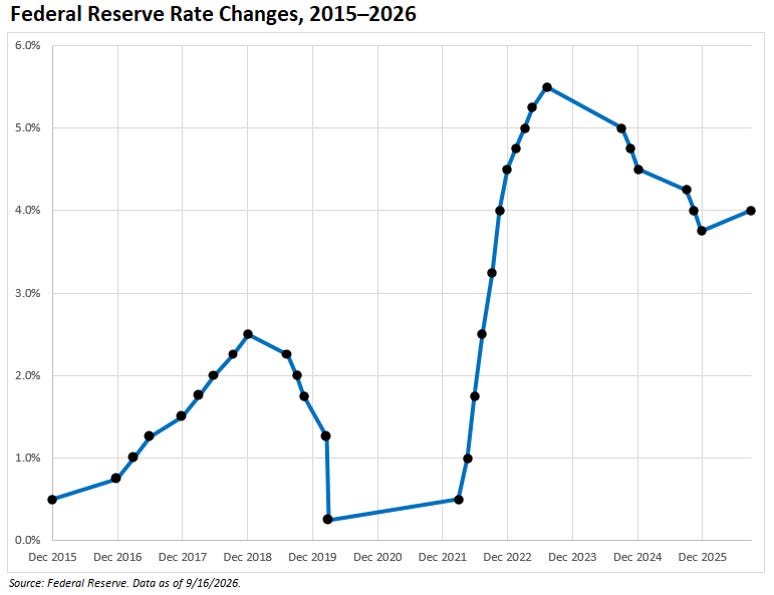
Interest rate hikes themselves are not necessarily bad for stocks, especially if they are expected. What the stock market does not like is shocks. The jump in inflation that occurred in 2022 was an example of a shock. Prices soared as post-pandemic consumer demand rebounded more strongly than supply chains could handle. This led to soaring inflation, higher bond yields and a bear market in stocks.
Fast forward to today, and we’re seeing the impact of oil exports being disrupted not only in the Strait of Hormuz but now also in the Red Sea, as Houthi rebels are blockading Persian Gulf oil from transiting the Bab el-Mandeb Strait.
Given the upward pressure on inflation, a rate hike was anticipated.
The updated forecasts from FOMC participants (aka the dot plot) suggest that another 0.25% rate hike could be announced at either the October or December meeting. The CME FedWatch Tool shows traders pricing in a 50% chance of a third rate hike occurring by the January meeting. The FOMC’s projections and traders’ expectations are subject to change.
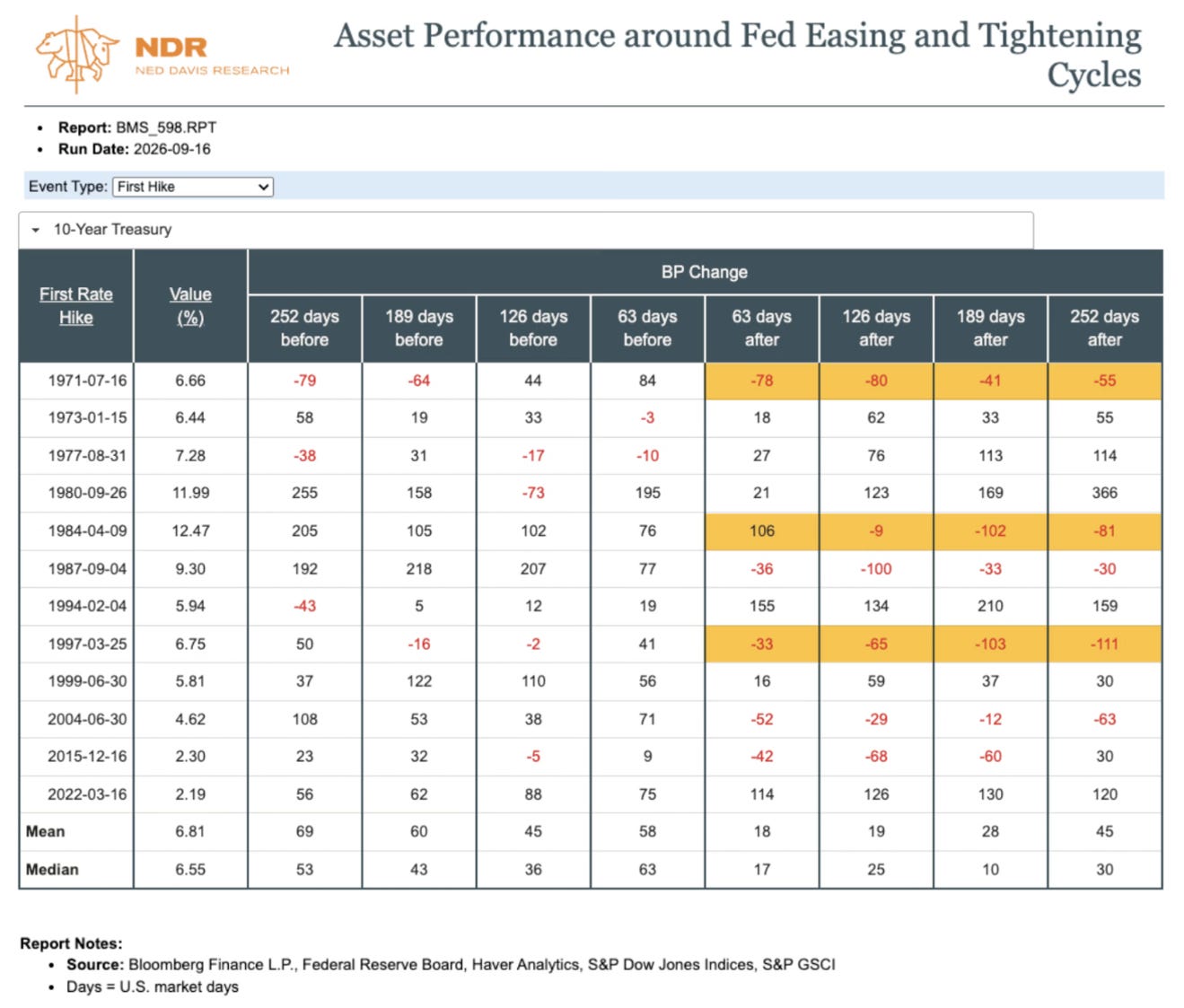
According to Joe Kalish of Ned Davis Research, bond yields “are likely to be significantly lower six to 12 months from now” if yesterday’s rate hike turns out to be “a non-cycle (fewer than three hikes).” Kalish cited three such non-cycles where this pattern occurred: July 1971, April 1984, and March 1997.
Regardless of what happens next, shifts in monetary policy—especially small rate hikes like this—should not change your long-term investing strategy. Those seeking to make tactical changes around the edges of their portfolio should be careful not to chase after ships that have already sailed.
There are opportunities in the current market for those with excess cash, maturing certificates of deposit (CDs) or maturing bonds. Yields on money market funds have risen. So have yields on CDs, preferred stocks and bonds—particularly those at the middle and longer end of the curve, which are offering juicier yields.
As far as stocks are concerned, corporate earnings are expected to remain strong. Overall, breadth remains good too, with both the S&P 500 Equal Weight index and the S&P SmallCap 600 index beating the S&P 500 index year to date. Foreign stocks—particularly those from developed countries—are also having a good year. As always, seek out profitable companies trading at attractive valuations.
Most importantly, remember that while you can’t control monetary policy, economic conditions or Mr. Market, you can choose to stay focused on following your long-term strategy.