

“Experience is the teacher of all things.” This translated quote from Julius Caesar’s “De Bello Civili” applies as much to investing and running as it did to the Roman dictator’s commentary on war. Nothing prepares you for being in the moment as much as prior experience does.
I bring this up because it ties directly to a conversation I had last week with long-time AAII Journal contributor John Deysher. While meeting up after I got my race-day shirt for the TCS New York City Marathon, our conversation veered to the speculative actions of investors in the current environment. Deysher raised the point that we have not experienced a lengthy and severe bear market since the global financial crisis.
No risk tolerance questionnaire provided by a broker can predict how you will act when the S&P 500 index falls by 57% as it did between October 2007 and March 2009. Saying you are able to stand pat with your allocation or buy on the dip is much easier than actually doing it when market and economic conditions are so severely strained.
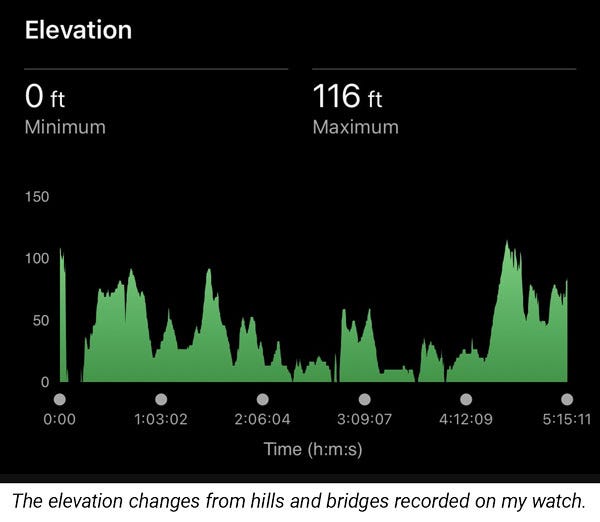
The same applies to running. No course description could have fully prepared me for how tough it was to run on New York City’s many hills and bridges. Illinois, where I live, is among the flattest states in the U.S.
I was among the 61,146 finishers on Sunday—which made the New York City marathon the largest in the world—because of a few key things I’ve learned through experience that are also applicable to investing.
Have a strategy and rules: When I showed up at the starting line last weekend, I already knew that I was going to run with a pace runner (a person whose job it is to finish at a preset time). I also had a Plan B in case I needed to slow down, which occurred after coming off the 1.5-mile Queensboro Bridge at mile 16.
For investing, this involves having rules for what defines an attractive investment (stock, ETF, etc.) and what would cause you to sell it. Your sell rules should be clear enough to make it easy to discern between typical price volatility and signs that either the investment is no longer attractive or you were wrong about it.
Listen to Your Mind and Body: There is a difference between being uncomfortable and being ill or hurt. My first goal at any race is to finish standing up. I always monitor my heart rate and never hesitate to slow down if it rises above a certain level. I am also attuned enough to know when I’m feeling modestly fatigued (which I can push through) versus feeling pain (which means something is wrong).
It took time to develop this awareness. The same was true for me as an investor: It took time to recognize how my risk tolerance shifts between normal market volatility and significant downturns.
Your willingness to own investments with greater price volatility will always be higher when market conditions are good than when they are turbulent. This is why I describe the optimal allocation as one you can stick with no matter what the market is doing. Such an allocation will help keep you from locking in large losses and causing lasting harm to your portfolio when the market drops.
Trust Your Training, Experience and Rules: I showed up at the starting line with 14 weeks of training that started at a higher mileage base. I also had the experience of having run 17 half marathons and three prior full marathons. I knew what I was capable of doing, where my limits were and how I needed to adapt to various conditions (weather, fatigue, etc.).
Many of you reading this have years of investing experience. Use it to your advantage. Set up rules to repeat the processes that led to good decisions and guardrails to avoid repeating past mistakes in your decision-making.
Those of you who are newer to investing should consider keeping a diary where you can review what has worked well for you and what hasn’t.
Most importantly, remember that the main goal of running is to be healthy and the main goal of investing is to have the assets you need at the time you intend to use them. Being able to continue participating is always the first step in learning from experience. You can’t run if you are hurt and you cannot invest if you are broke.
My Team Abbott Singlet
I ran the marathon as a member of Team Abbott. Team Abbott is a community of runners who have overcome health challenges and made an impact in their community. Abbott Laboratories (ABT) provided me with the entry into the New York City marathon, training support and race-related amenities. Abbott Laboratories also allowed me to use the race to fundraise for Sharsheret, a non-profit organization that supports women with breast and ovarian cancer.
I mention this because Abbott Laboratories is held in the AAII Dividend Investing model portfolio. We apply the same portfolio rules to Abbott Laboratories as we do to all other stocks.

AAII Sentiment Survey
Pessimism among individual investors about the short-term outlook for stocks increased in the latest AAII Sentiment Survey. Meanwhile, optimism and neutral sentiment decreased.
Bullish sentiment, expectations that stock prices will rise over the next six months, decreased 3.7 percentage points to 34.1%. Bullish sentiment is below its historical average of 37.5% for the second time in three weeks.
Neutral sentiment, expectations that stock prices will stay essentially unchanged over the next six months, decreased 3.2 percentage points to 17.5%. Neutral sentiment is unusually low and is below its historical average of 31.0% for the 35th consecutive week.
Bearish sentiment, expectations that stock prices will fall over the next six months, increased 6.9 percentage points to 48.4%. Bearish sentiment is unusually high and is above its historical average of 31.5% for the 39th consecutive week.
The bull-bear spread (bullish minus bearish sentiment) decreased 10.7 percentage points to –14.3%. The bull-bear spread is unusually low and is below its historical average of 6.5% for the 16th consecutive week.
This week’s special question asked AAII members what they thought about the Federal Reserve’s decision to keep interest rates unchanged.
Here is how they responded:
It was the right move: 55.5%
They should have raised rates: 30.7%
They should have cut rates: 6.6%
Not sure/no opinion: 7.3%
This week’s Sentiment Survey results:
Bullish: 34.1%, down 3.7 points
Neutral: 17.5%, down 3.2 points
Bearish: 48.4%, up 6.9 points
Historical averages:
Bullish: 37.5%
Neutral: 31.0%