

Note: My six-week Income Investing Seminar kicked off today, but it’s not too late to register. I’m covering dividends, bonds, income diversifiers and retirement tax strategy in one cohesive framework. For only $199, you get live access to all six sessions, plus lifetime access to all recordings and materials. Join us.
Those of you who own one or more semiconductor stocks or exchange-traded funds (ETFs) have a nice problem: determining whether to hold or cash in your chips.
To say that semiconductor stocks have been on a roll over the past two months is an understatement. Between March 31 and June 3, the median gain for the 19 semiconductor and semiconductor equipment stocks in the S&P 500 index is 55%. Four of these stocks more than doubled in price over that period: Advanced Micro Devices Inc. (AMD), Intel Corp. (INTC), Micron Technology Inc. (MU) and ON Semiconductor Corp. (ON).
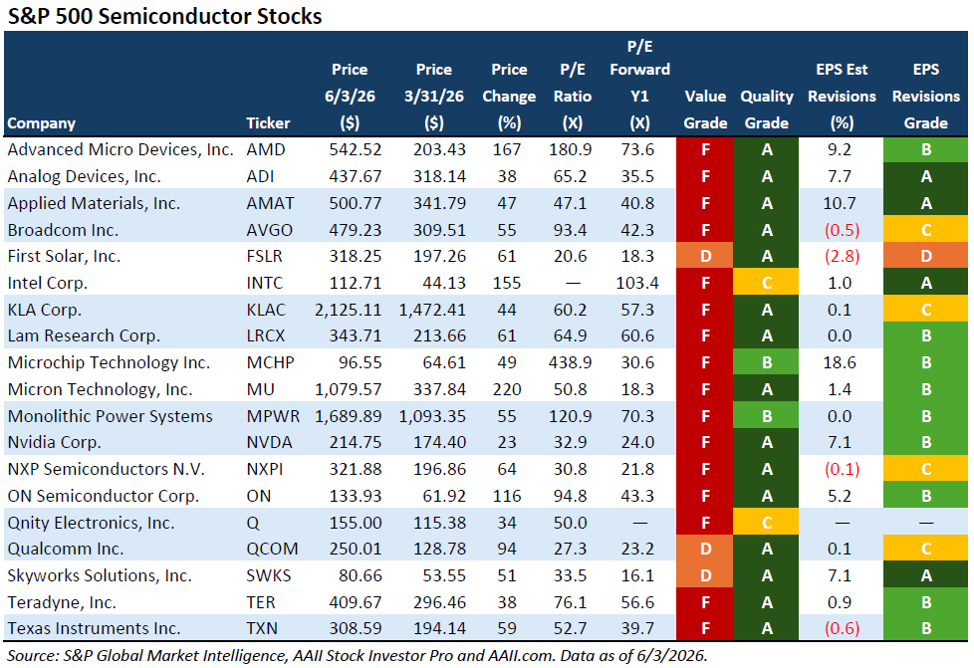
Such big short-term moves can be challenging because they are driven primarily by sentiment and not fundamentals. A few key metrics can help you to determine your best next move.
Valuation: Valuations for most of these stocks are high. The median trailing price-earnings (P/E) ratio is 56.5. Looking at projected earnings for one year out (fiscal-year 2027 for most companies), the median forward price-earnings ratio is 40.3. Those of you who have valuation-based sell rules should take these multiples into consideration. Value strategies are intended to buy low and sell high. Most of these stocks have an A+ Value Grade of F (very expensive). The Value Grade looks at six valuation ratios.
Fundamentals: Weak fundamentals paired with a soaring stock price is a dangerous combination. Low returns on assets (ROA), rising debt or negative cash flow are reasons to question a high valuation. The A+ Quality Grade factors in these and other measures of fundamental strength. Fifteen of the 19 stocks have a very strong Quality Grade of A.
Earnings Estimate Revisions: A soaring price can be justified if analysts are revising their expectations for a company’s earnings upward. Negative earnings estimate revisions signal a disconnect between analysts’ projections for future earnings and what the market is pricing in. Timing also plays a role, as analysts are less likely to meaningfully adjust their forecasts in the weeks leading up to a quarterly earnings announcement. The current A+ Earnings Estimate Revisions Grade for Broadcom Inc.
(AVGO) does not yet reflect its fiscal second-quarter 2026 earnings results and updated guidance, which were announced yesterday.
Portfolio Weight: Pay attention to how much of your portfolio is allocated to one or more semiconductor chip stocks. If your allocation is large compared to that of your other holdings, consider whether it makes sense to reduce your exposure. All AAII model portfolios target an equal-weight allocation (portfolio value ÷ number of stocks held). If a stock becomes excessively large (e.g., more than 2x the average position size for AAII Dividend Investing and 2.5x for VMQ Stocks), it is trimmed to be closer to an equal-weight position. Applying the rule consistently matters more than where you set the threshold for trimming.
Though not an investing rule, I personally acknowledge the role of good luck when managing my portfolio. If a stock jumps significantly in a short time, I will sell part of my position and reinvest the proceeds into an index fund. It is not always optimal, but it does recognize that the market gave me an unexpected gift.

More on AAII.com
Understanding AAII’s Revised Value Grade
AAII’s Value Grade for stocks incorporates six fundamental variables into a single value grade to help judge which stocks are potential bargains and which are expensive.AAII’s Quality Grade Undergoes Expansion: Looking Behind the Curtain
Based on research into various components that reflect a company’s “quality,” we tweaked the quality grade for stocks.Why Tracking Earnings Estimate Revisions Pays Off
Screens based on upward revisions have shown a historical ability to identify potential outperformers, as discussed in the June 2026 AAII Journal.
AAII Sentiment Survey
Pessimism among individual investors about the short-term outlook for stocks decreased in the latest AAII Sentiment Survey. Meanwhile, optimism and neutral sentiment increased.
Bullish sentiment, expectations that stock prices will rise over the next six months, increased 0.7 percentage points to 36.3%. Bullish sentiment is below its historical average of 37.5% for the third consecutive week.
Neutral sentiment, expectations that stock prices will stay essentially unchanged over the next six months, increased 4.1 percentage points to 26.7%. Neutral sentiment is below its historical average of 31.5% for the 98th time in 100 weeks.
Bearish sentiment, expectations that stock prices will fall over the next six months, decreased 4.9 percentage points to 37.0%. Bearish sentiment is above its historical average of 31.0% for the 17th consecutive week.
The bull-bear spread (bullish minus bearish sentiment) increased 5.6 percentage points to –0.7%. The bull-bear spread is below its historical average of 6.5% for the 16th time in 17 weeks.
This week’s special question asked AAII members which factor is most influencing their six-month outlook for stocks.
Here is how they responded:
The economy and/or inflation: 34.8%
Geopolitics: 33.6%
Valuations: 16.4%
Monetary policy/interest rates: 9.6%
Other: 5.6%
This week’s Sentiment Survey results:
Bullish: 36.3%, up 0.7 points
Neutral: 26.7%, up 4.1 points
Bearish: 37.0%, down 4.9 points
Historical averages:
Bullish: 37.5%
Neutral: 31.5%
Bearish: 31.0%
See more Sentiment Survey results.

AAII Asset Allocation Survey
Individual investors’ allocations to stocks increased while bond and cash allocations decreased in the May AAII Asset Allocation Survey.
Stock and stock fund allocations increased 1.3 percentage points to 69.8%. Stock and stock fund allocations are above their historical average of 61.5% for the 72nd consecutive month.
Bond and bond fund allocations decreased 0.7 percentage points to 14.9%. Bond and bond fund allocations are below their historical average of 16.0% for the seventh time in eight months.
Cash allocations decreased 0.6 percentage points to 15.3%. Cash allocations are below their historical average of 22.5% for the 42nd consecutive month.
May AAII Asset Allocation Survey results:
Stocks and Stock Funds: 69.8%, up 1.3 percentage points
Bonds and Bond Funds: 14.9%, down 0.7 percentage points
Cash: 15.3%, down 0.6 percentage points
May AAII Asset Allocation Details:
Stocks: 32.0%, up 2.4 percentage points
Stocks Funds: 37.8%, down 1.2 percentage points
Bonds: 4.0%, down 0.6 percentage points
Bond Funds: 11.0%, down 0.0 percentage points
Historical averages:
Stocks/Stock Funds: 61.5%
Bonds/Bond Funds: 16.0%
Cash: 22.5%
Take the Asset Allocation Survey.