

Right now, many investors are asking themselves how the recent change in tariffs impacts their portfolio. Last week’s overturning of the tariffs announced last spring under the International Emergency Economic Powers Act (IEEPA) and the introduction of new 10% to 15% tariffs have created uncertainty. (The new tariffs are being imposed under Section 122 of the Trade Act of 1974 but can only be in place for a maximum of 150 days.)
The impact of these changes depends on which companies you invest in. Companies that are heavily reliant on imports, like apparel companies, should see reduced tariff costs but still face the new Section 122 tariff. Industrial companies that import steel and aluminum continue to face the higher steel and aluminum tariffs that were put in place in 2018 under Section 232 of the Trade Expansion Act of 1962. Service companies that are less reliant on imports may not see much change.
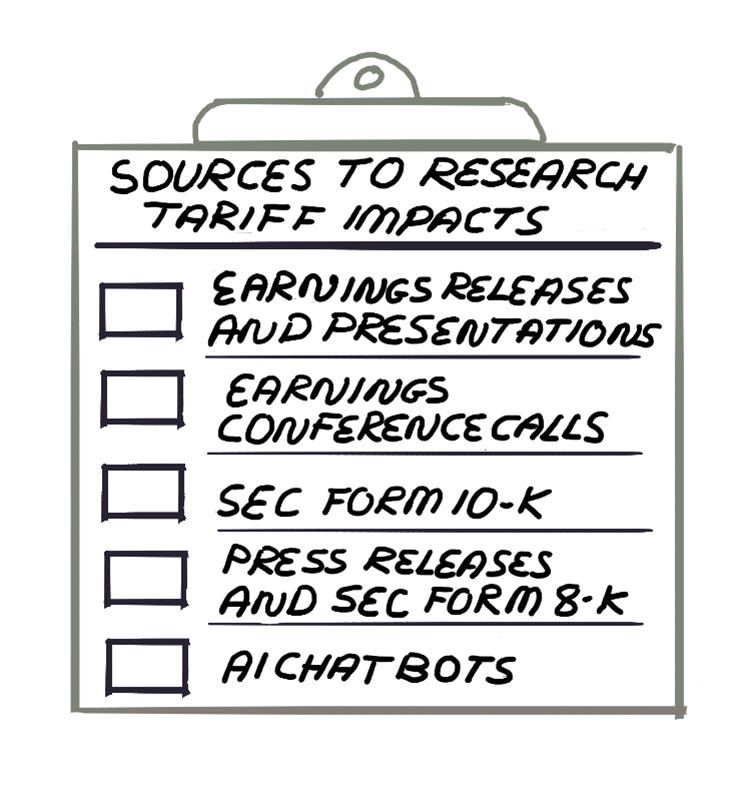
Determining the impact of the change in tariffs on a particular company requires a bit of research. There are several key places you can look and resources you can use to assist you. Here is a brief list.
Earnings Releases and Presentations: Most large-cap and many mid-cap companies reported their fourth-quarter 2025 results prior to Friday’s tariff ruling. Nonetheless, the earnings releases and the accompanying presentation materials can provide insight into the impact that tariffs have had so far on a particular company.
Earnings Conference Calls: Many companies post recordings of their earnings conference calls on their investor relations websites. Search online for “[Company] Investor Relations” to find them. Transcripts of earnings conference calls are also published on websites like Seeking Alpha. During prepared remarks or the question-and-answer session with analysts, executives may have provided information about tariff costs and the types of tariffs their companies have incurred.
Form 10-K: After the end of each fiscal year, publicly traded American companies are required to file Form 10-K with the U.S. Securities and Exchange Commission (SEC). This annual report provides information about the company, its suppliers and its financials. Pull up a company’s Form 10-K and search for the term “tariff” within the document to find the disclosures the company makes about which tariffs they have been paying and the cost of those tariffs. You may also be able to determine the source of the company’s supplies and materials. Form 10-K can be accessed in the SEC’s EDGAR database.
Press Releases and Form 8-K Disclosures: Companies with larger tariff impacts may update their earnings guidance or at least revise their projected tariff costs. Such updates may be disclosed via a press release or during a presentation to investors or analysts. If the disclosure is material, the company must file a Form 8-K in accordance with SEC fair disclosure rules. Form 8-K filings can also be found in the EDGAR database.
Artificial Intelligence (AI) Chatbots: ChatGPT, Claude, Gemini or Perplexity can help you quickly compile tariff-related information from multiple sources. Ask specific questions like “What is [company]’s tariff exposure based on recent filings?” or “Summarize all tariff references from [company]’s latest earnings call.” I always ask the chatbots to use reputable sources and then verify the information. AI is best used for initial research. It can quickly pull together an overview of tariff impacts for your entire portfolio if you give it a list of the stocks you invest in.
As you conduct your analysis, keep in mind that the tariff situation is evolving. The Section 122 tariffs will expire this July. What tariffs will be implemented after their expiration remains to be seen. This will occur against the backdrop of the midterm election.

More on AAII.com
How to Read a 10-K Filing
This annual report, required by the SEC, offers insight into a company’s business and the potential risks shareholders may face.AI for Financial Document Analysis: Your Net in a Sea of Information
Quickly processing news and reports with AI tools allows your finite attention to focus on interpretation and decision-making.How to Pinpoint the Right Fund for Your Needs
The February 2026 AAII Journal gives tips and tools to help you easily identify the perfect fund for your portfolio.
AAII Sentiment Survey
Pessimism among individual investors about the short-term outlook for stocks increased in the latest AAII Sentiment Survey. Meanwhile, optimism and neutral sentiment decreased.
Bullish sentiment, expectations that stock prices will rise over the next six months, decreased 1.3 percentage points to 33.2%. Bullish sentiment is below its historical average of 37.5% for the second time in 13 weeks.
Neutral sentiment, expectations that stock prices will stay essentially unchanged over the next six months, decreased 1.5 percentage points to 27.0%. Neutral sentiment is below its historical average of 31.5% for the 84th time in 86 weeks.
Bearish sentiment, expectations that stock prices will fall over the next six months, increased 2.8 percentage points to 39.8%. Bearish sentiment is above its historical average of 31.0% for the sixth time in 13 weeks.
The bull-bear spread (bullish minus bearish sentiment) decreased 4.1 percentage points to –6.6%. The bull-bear spread is below its historical average of 6.5% for the third time in 13 weeks.
This week’s special question asked AAII members how they would describe the earnings guidance given by companies during fourth-quarter 2025 earnings season.
Here is how they responded:
Better than I expected: 27.2%
Approximately what I expected: 43.5%
Worse than I expected: 7.6%
Not sure/no opinion: 21.2%
This week’s Sentiment Survey results:
Bullish: 33.2%, down 1.3 points
Neutral: 27.0%, down 1.5 points
Bearish: 39.8%, up 2.8 points
Historical averages:
Bullish: 37.5%
Neutral: 31.5%
Bearish: 31.0%
See more Sentiment Survey results.