

Part of the appeal of exchange-traded funds (ETFs) is their low expense ratios. As a group, ETFs are inexpensive to own. But not all ETFs are inexpensive. Some are costly, including those that are widely held.
I made the broader point about not assuming that all ETFs are cheap at last week’s BetterInvesting National Convention. Afterward, it occurred to me that having examples in my presentation would have better emphasized the point. It is always challenging to know exactly how much information can be put into a slide deck without going over the time limit.
So, when I got home, I used AAII’s ETF Screener to identify large-cap ETFs with at least $1 billion in assets under management (AUM) that had high expense ratios. I found eight ETFs whose expense ratios rank in the top 20% of their respective categories and have been in existence for at least one year.
The average expense ratio for these eight ETFs was 0.75%. To put this into perspective, the average expense ratios for the large blend, large growth and large value categories are 0.43%, 0.50% and 0.37%, respectively. It is easy to find ETFs with expense ratios of 0.10% or lower in these categories.
Here are those eight costly ETFs.
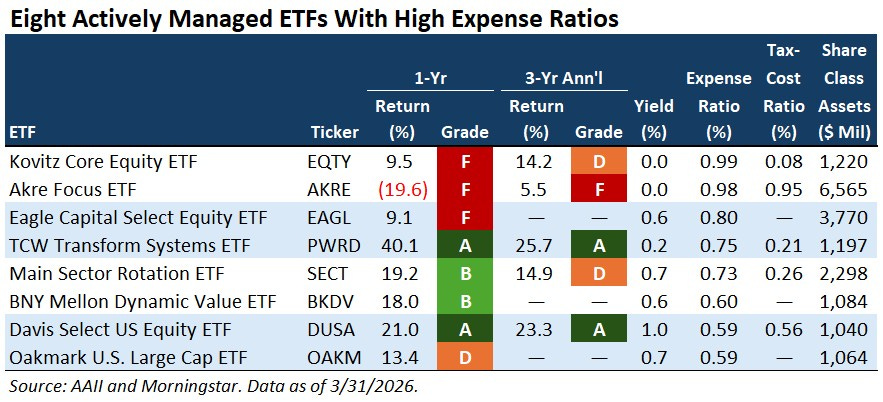
Taxes add to the cost of ownership. Akre Focus ETF (AKRE) has a tax-cost ratio of 0.95%. Davis Select US Equity ETF (DUSA) has a tax-cost ratio of 0.56%. These numbers imply that an investor in the highest tax bracket saw their returns reduced by 0.95% and 0.56% by taxes owed on the distributions. (The tax-cost ratio assumes that the ETF is held in an individual taxable account.)
Active Management Is a Common Thread
The continuing growth of active fund management within the ETF industry is a common thread connecting these eight ETFs.
Two of the ETFs, Akre Focus and Kovitz Core Equity ETF (EQTY), formerly existed as actively managed ETFs. Davis Select US Equity and Oakmark U.S. Large Cap ETF (OAKM) make use of the approaches followed by their respective issuers’ mutual funds. In all four cases, the higher expenses can be attributed at least in part to the fund sponsors’ backgrounds in running actively managed mutual funds.
This is part of a broader trend. Sponsors of actively managed mutual funds have been moving into the ETF space. We are about to see many more. Last month, Dimensional Fund Advisors launched DFA US Micro Cap ETF (DFMC), a share class of DFA U.S. Micro Cap I fund (DFSCX). While Dimensional Fund Advisors’ funds are lower cost, I expect many of the forthcoming ETF share classes of actively managed mutual funds to have high expense ratios for their respective ETF categories.
The importance of low expense ratios is a drum that we at AAII constantly beat. The less you spend on fund expenses, the more money you have to save and invest. This is a point I emphasized while speaking at the BetterInvesting National Convention.
More expensive large-cap ETFs exist. What separates these eight is that they are widely held, with each having more than $1 billion in AUM. Investors are buying them without considering the cost of ownership something we encourage you to never do.

More on AAII.com
Active Strategies That Have Fared Well Among Mutual Funds and ETFs
When evaluating active strategies, consider manager tenure, differentiated strategies and segments with less competition for active managers.The Great Migration: What’s Behind ETF Asset Growth
A growing number of asset managers are converting traditional mutual funds into ETFs or preparing to offer ETFs as a mutual fund share class.Using New Highs and New Lows to Measure Market Breadth
The new highs/new lows indicator provides a simple yet powerful window into the market’s internal health, as illustrated in the April 2026 AAII Journal.
AAII Sentiment Survey
Optimism among individual investors about the short-term outlook for stocks decreased in the latest AAII Sentiment Survey. Meanwhile, neutral sentiment and pessimism increased.
Bullish sentiment, expectations that stock prices will rise over the next six months, decreased 7.9 percentage points to 38.1%. Bullish sentiment is above its historical average of 37.5% for the second time in 11 weeks.
Neutral sentiment, expectations that stock prices will stay essentially unchanged over the next six months, increased 2.6 percentage points to 22.2%. Neutral sentiment is unusually low and is below its historical average of 31.5% for the 93rd time in 95 weeks.
Bearish sentiment, expectations that stock prices will fall over the next six months, increased 5.3 percentage points to 39.7%. Bearish sentiment is above its historical average of 31.0% for the 12th consecutive week.
The bull-bear spread (bullish minus bearish sentiment) decreased 13.2 percentage points to –1.6%. The bull-bear spread is below its historical average of 6.5% for the 11th time in 12 weeks.
This week’s special question asked AAII members how they would describe the current valuation of stocks.
Here is how they responded:
Stocks, in general, are overvalued: 44.1%
Stocks, in general, are fairly valued: 16.2%
Valuations are mixed, with some stocks expensive and others cheap: 34.9%
Stocks, in general, are undervalued: 1.8%
Not sure/no opinion: 3.1%
This week’s Sentiment Survey results:
Bullish: 38.1%, down 7.9 points
Neutral: 22.2%, up 2.6 points
Bearish: 39.7%, up 5.3 points
Historical averages:
Bullish: 37.5%
Neutral: 31.5%
Bearish: 31.0%