


The group of S&P 500 index stocks with share prices above $1,000 has lost a member. Netflix Inc. (NFLX) recently split its stock 10-to-1, which brought the share price down to $107.57 per share at the end of November.
Nine members of the S&P 500 continue to trade above $1,000 per share (based on end-of-November prices). They are NVR Inc. (NVR), Booking Holdings Inc. (BKNG), AutoZone Inc. (AZO), Fair Isaac Corp. (FICO), Mettler-Toledo International Inc. (MTD), TransDigm Group Inc. (TDG), KLA Corp. (KLAC), Eli Lilly & Co. (LLY) and BlackRock Inc. (BLK). The first three stocks, with the highest share prices, are in the consumer discretionary sector. Only Fair Isaac and KLA Corp. belong to the information technology sector.
Three ongoing trends have contributed to the existence of a $1,000+ share price club among the S&P 500 companies. One is the very large gains realized by the S&P 500 since the global financial crisis (2007–2009). Another is the small number of companies that split their stock each year. We are well into the second decade of relatively few stock splits. The third coinciding trend is a greater acceptance of higher-priced stocks. Commission-free trading and fractional trading have only added to this acceptance.
In writing this week’s commentary, I revisited an Investor Update column I wrote in 2012. At that time, the average share price of an S&P 500 stock was $58.52. (The average price is now $228.40.) The highest-priced stock in the large-cap index back then was Priceline.com, which traded at $632.00 per share. Now, NVR Inc. leads the S&P 500 with a share price of $7,521.84.
Notably, Priceline, which was rebranded as Booking Holdings in 2018, is one of only two stocks from the 2012 list that still rank among the top 10 S&P 500 companies by share price. Booking Holdings now trades at $4,914.69 per share. AutoZone is the other stock. Its share price has risen from $372.45 in 2012 to $3,954.33 now. AutoZone last split its stock in 1994. Booking Holdings has not split its stock since conducting a reverse split in 2003 following the dot-com crash. Reverse splits reduce the number of shares to increase the share price.
Several other stocks on the 2012 list have since split their shares. Alphabet Inc. (GOOGL), Apple Inc. (AAPL), Chipotle Mexican Grill Inc. (CMG) and Mastercard Inc. (MA) have all split their high-priced stocks within the past five years.
Stock splits can help individual investors by making it easier to diversify. While fractional trading does allow you to allocate among several stocks, not all brokers offer this option.
What low or high prices don’t do is tell you much about valuation. Fundamental factors such as earnings or yield are required to determine if a stock is cheap, reasonably valued or expensive.
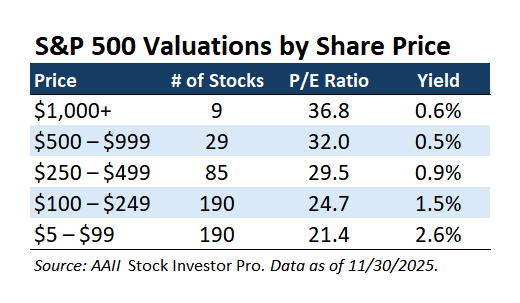
When we separate the S&P 500 member companies into share price buckets, we do see the impact of investor enthusiasm on valuations. Stocks whose share prices are at least $1,000 or between $500 and $999 have median price-earnings (P/E) ratios above 30.0. Stocks whose share prices are below $100 have a median price-earnings ratio of 21.4.
There are exceptions. NVR Inc.’s price-earnings ratio is just 16.5. Starbucks Corp. (SBUX), whose share price is $87.09, has a price-earnings ratio of 53.4. These two stocks exemplify why you should look beyond share price to determine whether a stock is pricey or a bargain. So, while the price of a single share of Netflix is now closer to $100 than $1,000, its price-earnings ratio remains high at 45.0.