


Featured Tickers:INTC
Because net income can mislead, cash flow and free cash flow are better indicators of a firm’s true financial health
Capex, working capital and reinvestment affect cash generation and business quality
Free cash flow metrics drive long-term shareholder value
When asked to evaluate a firm’s performance, many investors look at net income and price metrics such as the price-earnings (P/E) ratio. That’s understandable since earnings numbers are widely reported and tell us how profitable a firm is. Unfortunately, a firm can’t spend “profits.”
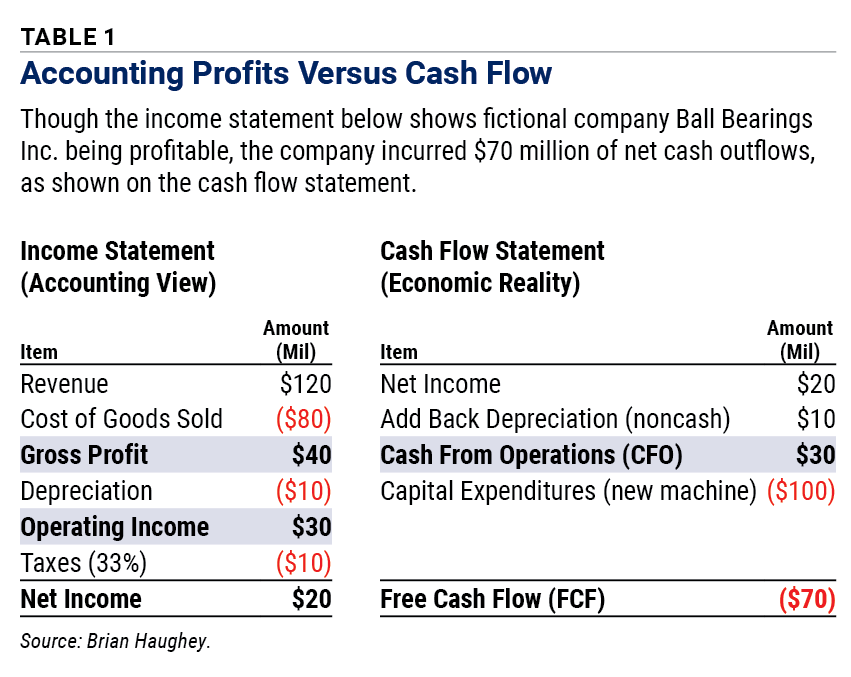
A firm can report positive net income yet be unable to meet its obligations. This is because operating expenses such as wages, payments to suppliers, interest on debt and taxes are paid in cash, not accounting profits. Consider a simple example using a fictional company. Ball Bearings Inc. has operated profitably for many years. Its existing equipment has become obsolete, so the firm buys a new machine for $100 million with an estimated useful life of 10 years. Rather than recognizing the entire $100 million in the first year, management depreciates (that is, spreads the cost of) the asset over its 10-year life, charging an expense of $10 million per year.
Suppose that the company has revenue of $120 million and costs of $80 million, so its gross profit is $40 million. Subtracting depreciation to reflect the pro-rata cost of the machine, operating income is $30 million ($40 million – $10 million). If taxes account for $10 million, then net income is $20 million ($30 million – $10 million).
Investors focused only on the income statement will see a profitable company. However, an investor who focuses on the cash flow statement will see a different picture. To calculate the cash generated by the firm, we start with net income ($20 million). To this, we add back depreciation because it isn’t a cash expense, so cash from operations (CFO) is $30 million ($20 million + $10 million). See the September 2024 AAII Journal article “Money in, Money out: What the Cash Flow Statement Reveals” to learn more about the cash flow statement.
However, cash from operations isn’t the whole story. When the firm purchased the machine, it incurred a capital expenditure (capex) of $100 million paid in cash. The firm’s change in cash is therefore $30 million from operations less the $100 million paid for the machine, resulting in an outflow of $70 million. Even though the firm showed an accounting profit, it burned through $70 million in cash. Unless it can obtain that cash via bank financing or in the capital markets, it may be unable to meet obligations such as paying suppliers or employees. In that case, the firm is unlikely to be able to continue its operations. (Table 1).
Therefore, to truly understand a firm, investors must follow the money. Doing so can shed light on the true quality of a business, even when net income is showing a different picture.
Net Income Is Not Cash
Because U.S. firms reporting GAAP earnings use accrual accounting, they report revenue when earned and expenses when incurred, even if cash has not been received or paid.
For example, a firm can report revenue today even if the customer has purchased on credit. As I explained above, a firm can expend cash on assets today while the cost is only recognized gradually through depreciation.
The earnings picture becomes even less clear if there’s a chance that some of the customers who purchased on credit may default. Management must make allowances for expected defaults, but how much is appropriate?
Similarly, management has discretion in setting the useful life of the recently purchased machine, and in determining the “appropriate” annual depreciation expense. Net income is therefore subject to management discretion. As noted author on shareholder value Alfred Rappaport observed, “Profits are an opinion. Cash is a fact.”
What Is Free Cash Flow?
Investors therefore often focus on free cash flow (FCF)—that is, the cash that is available to reward bondholders and shareholders or to reinvest in the business.
Net income reflects what the accountants say the company earned.
Cash from operations shows how much cash the business generated from its core operations (after adding back noncash expenses like depreciation and adjusting for changes in working capital).
Free cash flow shows how much is available after investing to maintain and expand the business.
Cash-focused investors begin by looking at cash from operations. Since cash from operations already reflects the readdition of depreciation and other noncash expenses, investors can use it but must still account for the firm’s capex. Maintenance capex is needed regularly just for the firm to continue in business—for example, by replacing machines that are becoming obsolete. Similarly, if the firm wishes to expand, growth capex is needed to fund the purchase of additional plant and equipment.
In general, free cash flow is equal to cash from operations minus capex. Some measures of free cash flow—such as Warren Buffett’s “owner earnings”—subtract only maintenance capex, while others use total capex. And since capex can be erratic, a five-year average is often used.
Working Capital’s Impact on Free Cash Flow
Cash and earnings can also diverge because of working capital, which is used to fund inventory and other expenses not funded by credit. Working capital is current assets less current liabilities.
When a firm is growing, more working capital is required to fund credit extended to customers (receivables), inventory and prepaid expenses. For example, if a company’s sales grow from $100 million to $150 million, it may need to carry 50% more inventory and extend 50% more credit to customers. Even though the income statement shows higher profits, the company must use cash today to fund that inventory and wait to collect from customers, reducing cash flow for this period. This is why high-growth firms can report significant earnings yet have negative free cash flow. It also explains why firms that misread the demand for their products and mismanage inventory, and firms that loosen their credit standards, may experience cash pressure well before earnings collapse.
Sources of Cash
As the September 2024 AAII Journal article explains, there are three sections on the cash flow statement.
Cash from operations (CFO): Cash resulting from the firm’s core operations
Cash from investing (CFI): Cash resulting from the firm’s net investments in assets
Cash from financing (CFF): Cash resulting from net capital issuance and redemption and dividends paid
Added together, cash from operations, cash from investing and cash from financing are equal to the net change in cash. As I noted previously, investors tend to focus on cash from operations and capex when computing free cash flow. But it’s also important to look at the financing section to see whether cash shortfalls are being funded by new debt or equity issuance as well as whether dividends are supported by cash generated internally.
Growth or Business as Usual?
Free cash flow can be used to finance capex, pay dividends, repurchase shares, reduce debt, fund acquisitions and build cash reserves. While free cash flow is important, how management allocates it is critical to a firm’s success.
As mentioned previously, maintenance capex is required to simply maintain the firm as a going concern, while growth capex allows the firm to expand. If free cash flow is low, or negative, that is not necessarily a bad sign if the firm is investing in growth, as free cash flow is reduced by capex. But if the firm is exhibiting relatively low growth, then weak free cash flow suggests that the firm may have to invest significantly in “maintenance” just to maintain revenue. Clearly, that would be worrisome, which is why Buffett’s owner earnings can be illuminating. The calculation is:
Owner Earnings ≈ Cash From Operations − Maintenance Capex
Investors should therefore ask whether capex is funding discretionary growth or nondiscretionary maintenance. In practice, however, this can be difficult to determine, as firms tend not to distinguish between maintenance and growth capex. Investors must estimate it by examining trends and the financial statements of peer firms.
Return on Reinvested Cash
Generating free cash flow is only part of the story. What ultimately determines shareholder value is how productively management reinvests available capital, including free cash.
To generate economic value, capex, acquisitions and internal investments must earn returns above the firm’s cost of capital. When this is the case, future cash flows grow and intrinsic value rises; conversely, when returns are poor, value is being destroyed and free cash flow is squandered.
In other words, significant free cash flow does not by itself guarantee strong shareholder outcomes in the future. Investors should focus not only on how much cash is generated, but also on the returns earned on incremental invested capital.
The Different Types of Free Cash Flow
Opening a financial textbook will reveal that there are several variants of free cash flow. The way to think about these is to consider where the “free cash” is flowing and how it is calculated.
I have already mentioned one variant, measured as cash from operations less capex. This is generally how firms report free cash flow. A second variant is called free cash flow to the firm (FCFF), while a third variant is called free cash flow to equity (FCFE).
Reported Free Cash Flow: Cash From Operations – Capex (Note: Because cash from operations starts from net income, which already includes interest paid, this measure is effectively post-interest cash flow.)
Free Cash Flow to the Firm: Cash flow available to both debt and equity holders, often calculated by adding back aftertax interest expense to reported free cash flow to show cash before payments to capital providers
Free Cash Flow to Equity: Cash flow available to equity holders after debt service and net borrowing effects
Investors typically use reported free cash flow as the operational “cash the business throws off” when judging the company’s performance.
They tend to use free cash flow to the firm when valuing the firm relative to its enterprise value (FCFF/EV), where enterprise value is the cost to acquire total control of the firm. It is calculated as the market value of both equity and debt, less the firm’s cash position. Free cash flow to the firm is usually discounted at the weighted average cost of capital, which includes both equity and debt.
Free cash flow to equity is used to value just the equity and is typically discounted at the cost of equity. For shareholders, free cash flow to equity is critical because it is the long-run source of payouts to shareholders. Over time, dividends and buybacks cannot exceed free cash flow to equity without raising new capital or drawing down cash.
Free Cash Flow Conversion
Investors can gauge where cash is going by comparing it to net income. One common metric is the free cash flow conversion ratio, calculated as free cash flow divided by net income. This ratio compares earnings to cash.
Free Cash Flow Conversion < 100%: This suggests heavy capex investment, working-capital build or noncash components.
Free Cash Flow Conversion ≈ 100%: Earnings translate into cash after capex. Earnings quality looks solid.
Free Cash Flow Conversion > 100%: Cash is strong relative to earnings. (Working-capital release or depreciation is greater than maintenance capex.)
A reasonable rule of thumb is to look for a free cash flow conversion ratio above 0.8 (80%), a benchmark reflecting the fact that most mature businesses reinvest a significant share of earnings to maintain operations. However, this is a benchmark, not an absolute rule, and varies significantly by industry. Capital-light businesses like software may show conversion ratios above 1.0, while capital-intensive industries like utilities or manufacturing may consistently show ratios of 0.5 to 0.7.
Excellent companies investing heavily in growth may show poor conversion ratios during their investment phases, sometimes preceding strong turnarounds. Weak companies, on the other hand, can have impressive conversion ratios that are not sustainable because they are underinvesting, hindering future prospects.
Free Cash Flow per Share
While investors often focus on total free cash flow, ultimately what matters is free cash flow per share.
Even though a firm can report steady increases in free cash flow, existing shareholders will receive little benefit if new shares are being issued through stock-based compensation (SBC) or through equity offerings.
This is particularly important in the technology sector and other industries with significant stock-based compensation. Although stock-based compensation is added back to cash from operations as a noncash expense, it represents real economic dilution. If free cash flow is growing but the share count is rising at the same time, each shareholder’s claim on that cash may be stagnant or declining. The same is true of firms that have convertible debt or preferred shares outstanding.
For this reason, investors should examine both total free cash flow and free cash flow per share to confirm that cash generation is truly accruing to current owners.
Why Analyzing Free Cash Flow Matters
Free cash flow can explain company share price performance. If we look at Intel Corp. (INTC) in Table 2, we can see that operating cash flow declined sharply from 2020 through 2024, while capex remained very large. Even as net income was declining, the firm embarked on an aggressive program of retooling its chip fabrication business. The result was sustained negative free cash flow, starting with a sharp downturn in 2022. This illustrates how heavy reinvestment needs can swamp cash generation even for a large firm.
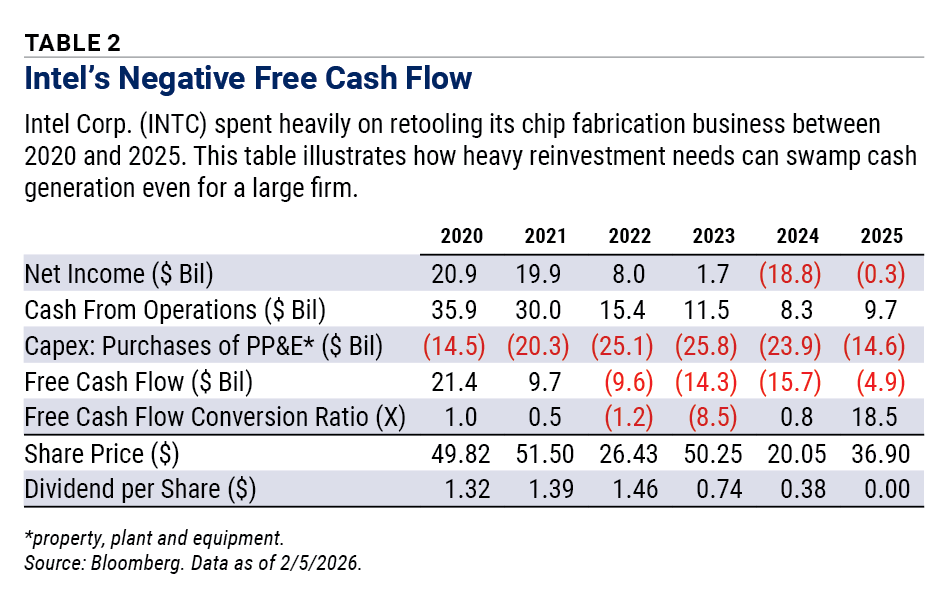
This pattern highlights the pressures that highly capital-intensive technology firms can face. In particular, note how this differs from a cyclical downturn. Intel’s negative free cash flow reflects the need to invest in a structural rebuilding of its manufacturing base, rather than merely being the result of temporary or cyclical weakness in demand. As their products become outdated or even obsolete, they must reinvest to remain technologically relevant, but those investments occur while operating performance is under pressure. This causes free cash flow to turn negative and remain so until the reinvestment bears fruit.
For Intel shareholders, the reduction in cash flows led to pressure on dividends, which were cut in 2023 before being eliminated. A key point for investors to remember is that traditional valuation models, based on earnings, become inappropriate when the firm is consuming cash rather than generating it. Investors are now betting on Intel’s multiyear business restructuring being successful, rather than simply purchasing a profitable business.
Even Cash Flow Can Mislead
Significant free cash flow is not always a sign of business strength. Sometimes firms can boost short-term free cash flow by cutting capex below maintenance levels, effectively running existing assets harder while deferring reinvestment.
Remember that reinvestment is always required to enable a firm to continue operating profitably on a “going concern” basis. Underinvestment that places a firm in “harvest mode” can temporarily inflate cash flow and conversion ratios, but it usually comes at the expense of future competitiveness. Over time, underinvestment can lead to declining product quality, market share losses or rising operating costs. It simply delays, and likely increases, the eventual investment required.
For this reason, unusually strong free cash flow should be examined carefully. Investors should ask whether cash generation reflects durable operating strength or simply postponed investment.
While cash flow can provide a more reliable picture of a firm’s operations, it too can be distorted. Investors should watch for:
Underinvestment (capex cut below maintenance levels);
Working capital adjustments (e.g., delaying payment of payables);
Receivables sales/factoring (selling receivables to a third party, often at a discount, to accelerate cash, which boosts current-period cash from operations but may not be sustainable);
One-time tax timing effects; and
Significant stock-based compensation that boosts cash flow from operations while diluting shareholders.
As with most metrics, it is the direction, rather than the absolute level, that can offer the most insight. Investors should look at multiyear patterns and determine if cash flow aligns with economic reality.
Summary
Over the long run, the value of a firm’s equity is driven by the present value of future free cash flows to shareholders. This is why free cash flow is not just an accounting exercise but is central to valuation.
The income statement tells investors what a company earned under accounting rules, but that doesn’t tell the whole story about the firm’s continued ability to operate profitably. Free cash flow helps answer the difficult, but more important, question: How much cash did the business truly generate after funding reinvestment needs?