

Artificial intelligence (AI) agents at investing platforms Public, Robinhood and Webull can read your brokerage account and place real trades in it (with effort on your part). Testing by Condor Capital Wealth Management found that these agents are not ready for prime time for most investors, including long-term investors.
Condor Capital used fully funded accounts at all three brokers to run three tests across combinations of Claude, ChatGPT and Gemini agents. Those tests were:
Run a simple robo-adviser–style 60% stock/40% bond account governed by an investment policy statement written by the AI agent for itself.
Use an identical script run by two AI agents at each of the three brokers (a capability matrix).
Instruct the AI agent to make as much money as it can, end the day in cash and never risk more than the account holds (an open-ended goal).
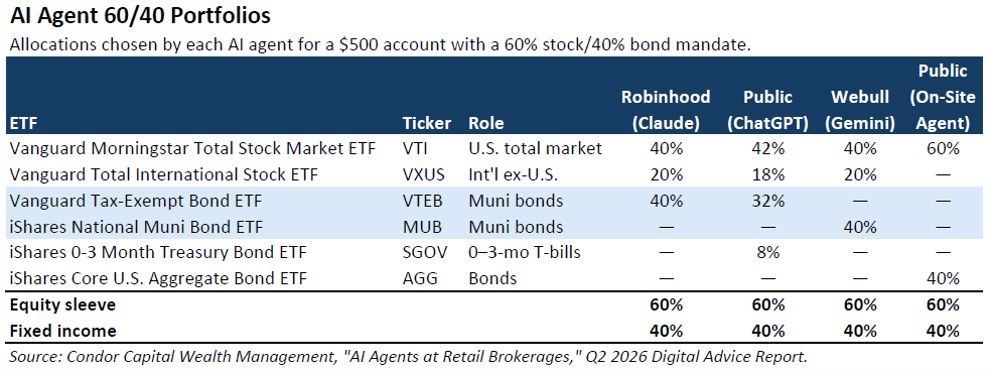
The robo-adviser–style 60% stock/40% bond portfolios created by the Claude, ChatGPT and Gemini agents, as well as the portfolio created by Public’s own on-site AI agent, showed a preference toward Vanguard exchange-traded funds (ETFs) on the equity side. While there is nothing wrong with using Vanguard ETFs, there are viable options from other fund families too. Condor Capital described the broader pattern this way: “The [robo-advisers] sell judgment plus implementation; the agents currently supply implementation only.”
The capability test found that the two AI agents “were essentially interchangeable across the prompts both ran on the same brokers.” The agents were also sometimes wrong about a broker’s rules, yet confident that they were right. For example, Gemini wrote in its investment policy statement that Webull only supported the trading of whole shares, even though the brokerage allows fractional shares to be traded in increments of at least $5. This may have been due to AI agents’ reliance on training data that doesn’t reflect current rules, regulations, tax law and brokerage capabilities.
In the third, open-ended goal test, Public’s AI agent (powered by ChatGPT) checked in every five minutes and made 13 round-trip (buy and sell) trades in a single day. The Robinhood AI agent (powered by Claude) checked in 10 times per day and journaled lessons to itself. The Webull AI agent (powered by Gemini) checked in a handful of times per day and only traded Nvidia Corp. (NVDA).
None of the three agents beat Vanguard Morningstar Total Stock Market ETF (VTI), which returned 3.1% over the first three trading days of August 2026. The Claude-powered Robinhood agent came the closest with a 2.9% three-day return. The Gemini-powered Webull agent described its 0.9% return as “a 100% win rate across three days of disciplined trading.”
Setting up these AI agents requires being comfortable working with connection protocols. Robinhood uses a connector-based setup—Model Context Protocol (MCP)—that feels similar to an ordinary app login page. Public and Webull require more technical steps that Condor Capital described as not for the faint of heart. Public also offers an AI agent that lives inside its brokerage app; Condor Capital expects this to become the configuration brokers will lean into.
Yesterday, I spoke to David Goldstone, manager of investment research for Condor Capital, about the broker AI agents. He described the agents as currently geared for day traders who want automated rules-based strategies.
Those of you who are interested in trying out one of these AI agents should start with small amounts. Goldstone suggested being very thoughtful about the instructions provided to the AI agent. Also understand that liability remains unclear if the AI agent makes a mistake. It may be better, according to Goldstone, to have the AI agent help you look for blind spots about where your strategy could go wrong instead of having it trade for you.
I would be remiss if I didn’t mention access to your personal accounts. The AI agent would have access to your brokerage account and the information within it. Though some AI agents will ask you to approve any trades before execution, you will need to be comfortable with giving this level of access to the AI agent.
Finally, understand that these AI agents are in the early stages of development and newer versions are being worked on. None of the largest brokers currently have such AI agents available to individual investors, and they have not indicated that they are currently planning to make them available.

More on AAII.com
2026 Robo-Advice Landscape: Survivors Search for the Next Leg of Growth
With most early adopters already established as clients, robo-advice platforms compete on scale, pricing, planning depth and customization.An Intro to AI-Powered Investing: How Individual Investors Can Leverage LLMs
Artificial intelligence can enhance investment research and decision-making, but it should be used carefully.Diversification and Discipline Drive Gains for Model Shadow Stock Portfolio
Read the October 2026 AAII Journal to find out how the model portfolio outperformed in a weak month for small stocks. Plus, review the latest portfolio changes.
AAII Sentiment Survey
Pessimism among individual investors about the short-term outlook for stocks decreased in the latest AAII Sentiment Survey. Meanwhile, optimism and neutral sentiment increased.
Bullish sentiment, expectations that stock prices will rise over the next six months, increased 5.6 percentage points to 40.3%. Bullish sentiment is above its historical average of 37.5% for the third time in six weeks.
Neutral sentiment, expectations that stock prices will stay essentially unchanged over the next six months, increased 1.9 percentage points to 20.8%. Neutral sentiment is unusually low and is below its historical average of 31.0% for the 31st consecutive week.
Bearish sentiment, expectations that stock prices will fall over the next six months, decreased 7.5 percentage points to 39.0%. Bearish sentiment is above its historical average of 31.5% for the 35th consecutive week.
The bull-bear spread (bullish minus bearish sentiment) increased 13.1 percentage points to 1.3%. The bull-bear spread is below its historical average of 6.5% for the 12th consecutive week.
This week’s special question asked AAII members where they are allocating new cash (e.g., from distributions, dividends or sales).
Here is how they responded:
Stock ETFs or mutual funds: 26.4%
Individual stocks: 25.7%
Cash equivalents [money market funds, certificates of deposit (CDs), Treasury bills]: 24.3%
Bonds or bond funds: 14.9%
I am spending the cash or have no new cash to allocate: 8.8%
This week’s Sentiment Survey results:
Bullish: 40.3%, up 5.6 points
Neutral: 20.8%, up 1.9 points
Bearish: 39.0%, down 7.5 points
Historical averages:
Bullish: 37.5%
Neutral: 31.0%
Bearish: 31.5%
See more Sentiment Survey results.

AAII Asset Allocation Survey
Individual investors’ allocations to cash decreased while stock and bond allocations increased in the September AAII Asset Allocation Survey.
Stock and stock fund allocations increased 0.7 percentage points to 71.8%. Stock and stock fund allocations are above their historical average of 61.5% for the 76th consecutive month.
Bond and bond fund allocations increased 0.3 percentage points to 14.9%. Bond and bond fund allocations are below their historical average of 16.0% for the seventh consecutive month.
Cash allocations decreased 1.0 percentage points to 13.3%. Cash allocations are below their historical average of 22.5% for the 46th consecutive month.
September AAII Asset Allocation Survey results:
Stocks and Stock Funds: 71.8%, up 0.7 percentage points
Bonds and Bond Funds: 14.9%, up 0.2 percentage points
Cash: 13.3%, down 1.0 percentage points
September AAII Asset Allocation Details:
Stocks: 33.4%, down 0.0 percentage points
Stocks Funds: 38.3%, up 0.7 percentage points
Bonds: 5.7%, up 0.6 percentage points
Bond Funds: 9.1%, down 0.4 percentage points
Historical averages:
Stocks/Stock Funds: 62.0%
Bonds/Bond Funds: 16.0%
Cash: 22.0%