

With all the bubble talk surrounding the recent jump in semiconductor and other technology stock prices, I’m surprised that the song “1999” by Prince and The Revolution isn’t being played more often. Talk of a bubble has expanded across financial news outlets.
Semiconductor and other technology-related stocks with exposure to artificial intelligence (AI) are having a moment. Many have soared in price since the ceasefire between the U.S. and Iran was announced at the end of March. Price spikes by themselves do not signal a bubble. But, they do raise questions as to whether there is too much exuberance.
There are ratios and other fundamental indicators that you can look at to determine whether the higher prices are warranted and if additional outperformance is possible. This week, I share several of these with you. Most are available to you as data fields in AAII’s My Portfolio tool should you want to build a custom view to track certain stocks.
In creating the tables below, I handpicked a sample of five technology-related stocks whose prices have risen significantly over the past several weeks. All were required to have reported this earnings season. They also all have exposure to AI directly or through chips and data centers.
Earnings Surprises and Estimate Revisions
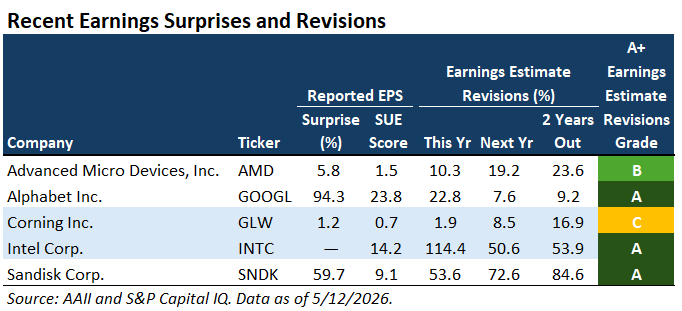
Earnings for the most recently completed quarter topped analysts’ expectations for all five companies. The standardized unexpected earnings (SUE) score was high for three of these companies: Alphabet Inc. (GOOGL), Intel Corp. (INTC) and Sandisk Corp. (SNDK). The SUE score factors in the spread between analysts’ estimates. Larger SUE scores indicate a truer surprise.
The earnings estimate revision metrics in this table show the extent to which analysts raised or lowered their expectations for future profits. Large percentage changes can occur when the older estimate is a small number. Analysts raised their full-year earnings estimates for Intel from $0.507 to $1.086 per share over the past 30 days. This is still significant because it implies a doubling of expected earnings. Notably, Corning Inc.’s (GLW) estimate revisions are smaller than the recent big jump in its stock price implies.
Earnings Growth Forecast
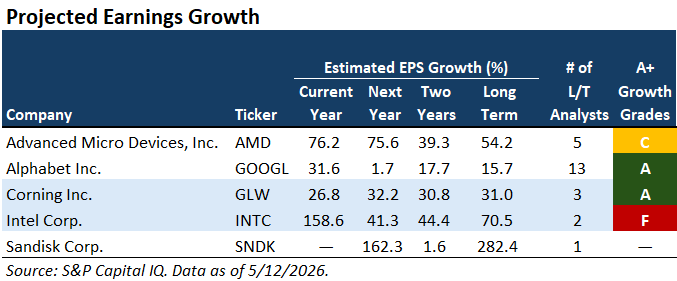
The enthusiasm in AI-related stocks is based on the perception of strong future earnings growth. Analysts are mostly forecasting very strong growth for these companies. Notably, analysts expect Alphabet’s earnings to stay relatively unchanged next year before resuming strong growth in 2028. Analysts call for the company to earn $14.230 per share this year, $14.465 per share in 2027 and $17.022 per share in 2028.
Intel’s very weak A+ Investor Growth Grade of F reflects its struggles over the past several years.
When looking at a company’s long-term earnings estimates, pay attention to how many analysts are providing forecasts. Only two analysts provide long-term growth rates for Intel, while just one does for Sandisk.
Valuations
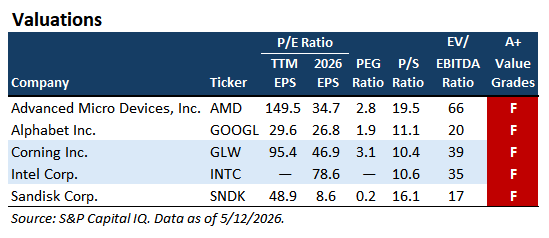
Strong expected growth rarely comes cheap, and that is what we generally see in the table below. The A+ Investor Grades for all five stocks are F (ultra expensive). While Alphabet’s price-earnings-to-earnings growth (PEG) ratio of 1.9 might seem reasonable to growth investors, its price-to-sales (P/S) ratio of 11.1 ranks among the most expensive 10% of stocks.
Fundamental Quality
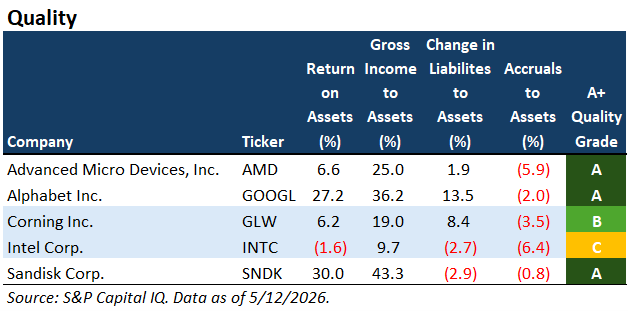
One key thing separating these companies from those of the late 1990s dot-com era is financial strength. Four of the five companies have a Quality Grade of either A (very strong) or B (strong). The return on assets (ROA) varies by company but is generally above the companies’ respective industry and sector medians. Intel has a negative return on assets because it incurred a full-year loss in 2025. The negative accruals-to-assets ratios are a good sign because they signal that net income is not exceeding cash from operations for any of the five companies.
Overall, the data shows fundamentally sound companies that are performing better than analysts expect. Future growth is projected to be generally strong, but investors are paying a high valuation for that growth. While the market is not partying like it’s 1999, the valuations of these stocks, and other AI-related stocks, imply elevated downside risk if the companies stumble.

More on AAII.com
Profiting From Analysts’ Revisions to Earnings Estimates
AAII tracks a series of separate screens that look for companies with recent earnings estimate revisions.AAII’s Quality Grade Undergoes Expansion: Looking Behind the Curtain
Based on research into various components that reflect a company’s “quality,” we tweaked the quality grade for stocks.Stock Market Winners: Nine Rules to Identify the Next Outperformers
The May 2026 AAII Journal discusses how examining promising stocks that rose to “super-stock” status reveals shared traits that can be used for screening.
AAII Sentiment Survey
Neutral sentiment among individual investors about the short-term outlook for stocks decreased in the latest AAII Sentiment Survey. Meanwhile, optimism and pessimism increased.
Bullish sentiment, expectations that stock prices will rise over the next six months, increased 1.0 percentage points to 39.3%. Bullish sentiment is above its historical average of 37.5% for the fourth consecutive week.
Neutral sentiment, expectations that stock prices will stay essentially unchanged over the next six months, decreased 4.7 percentage points to 24.1%. Neutral sentiment is below its historical average of 31.5% for the 95th time in 97 weeks.
Bearish sentiment, expectations that stock prices will fall over the next six months, increased 3.7 percentage points to 36.6%. Bearish sentiment is above its historical average of 31.0% for the 14th consecutive week.
The bull-bear spread (bullish minus bearish sentiment) decreased 2.7 percentage points to 2.7%. The bull-bear spread is below its historical average of 6.5% for the 13th time in 14 weeks.
This week’s special question asked AAII members what type of stocks they are favoring right now.
Here is how they responded:
Growth stocks: 21.1%
Dividend stocks: 17.0%
Value stocks: 13.2%
Small-cap stocks: 4.5%
A mix of the above/other: 43.8%
This week’s Sentiment Survey results:
Bullish: 39.3%, up 1.0 points
Neutral: 24.1%, down 4.7 points
Bearish: 36.6%, up 3.7 points
Historical averages:
Bullish: 37.5%
Neutral: 31.5%
Bearish: 31.0%
See more Sentiment Survey results.
