

Several members asked questions and posted comments in response to this month’s AAII Journal article “A New Form of Share Ownership: Issuer-Sponsored Tokens.” For those of you who have not read the article yet, stock transfer agent Computershare announced earlier this year that it will support U.S.-listed companies that choose to issue tokenized versions of their stocks.
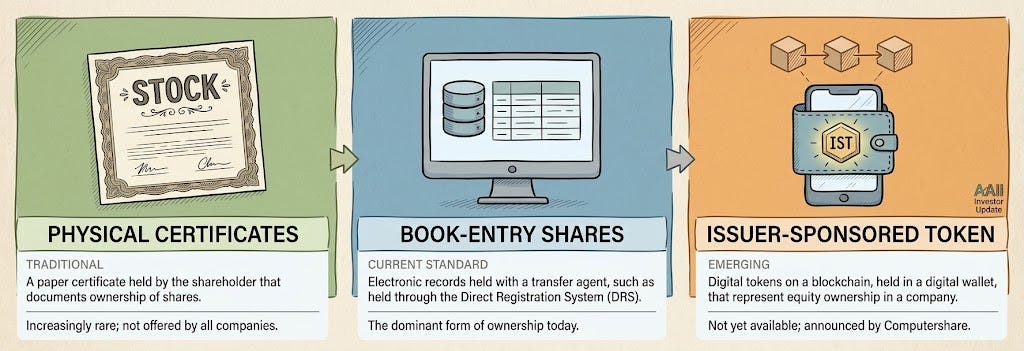
Issuer-sponsored tokens (ISTs) will be a third form of stock ownership. The other two options are physical stock certificates, when offered, and book-entry shares, such as shares held through the Direct Registration System (DRS).
The move toward tokenized shares involves many of the largest companies in the financial industry. More than 30 financial firms participated in a trial recently in which financial securities such as stocks and bonds were converted into digital tokens. Those companies included BlackRock, CME Group, Goldman Sachs, Invesco, J.P. Morgan, S&P Dow Jones Indices, Vanguard and others.
Here are the paraphrased questions from AAII members and my answers.
Why Would Someone Want an IST?
One reason is settlement. Tokenized shares will trade on a blockchain, providing instantaneous settlement. Another reason is the ability to hold stocks in a digital wallet. Though digital wallets are not widely used right now, this could change if stablecoins gain more traction. Both your stablecoins and your securities could conceivably be held in a single wallet, providing some simplicity.
Why Would I Forgo SIPC Coverage?
Forgoing coverage from the Securities Investor Protection Corp. (SIPC) is a trade-off that an investor must be comfortable making if they are interested in ISTs. Under current law, SIPC coverage does not extend to digital wallets held by individuals. Even brokers that offer cryptocurrency trading, such as Fidelity and Robinhood, hold those coins outside of the SIPC-member broker-dealer accounts where traditional securities—such as stocks, bonds and exchange-traded funds (ETFs)—are held.
How Will Tax Reporting Work for Tokenized Stocks?
Current tax rules require reporting of all digital asset transactions “whether or not they result in a taxable gain or loss.” Short- and long-term capital gains rules apply. Brokers that facilitate digital asset transactions are required to issue a Form 1099-DA. That said, regulations will need to catch up with evolving technologies.
How Is the Transfer Agent Notified of a Wallet-to-Wallet Transfer?
Transfers of ISTs from one digital wallet to another will be recorded on the blockchain. The transfer agent (e.g., Computershare) will then reflect the ownership record change on the company’s master securityholder file. Note that each issuer determines the specific blockchain(s) its IST can trade on and the type(s) of digital wallet(s) it can be held in. In addition, ISTs may only be transferred to individuals or entities that have been “allowlisted,” meaning that their identities have been verified, they have passed sanctions screening and are connected to their digital wallets.
Conclusion
I want to stress that officially tokenized stocks and bonds are still in their early stages. I use the word “officially” because some tokenized vehicles currently exist that track the price of an underlying asset. However, these tokenized vehicles don’t provide actual ownership of the underlying assets. Contrastingly, ISTs will represent actual equity ownership in the company.
It is uncertain when ISTs will start becoming available. The companies Computershare has spoken with were described to us as being in an “educational phase.” Once ISTs start launching, watching and waiting will be a prudent strategy.